
Why Most CDP Evaluations Miss the Point
Customer Data Platforms (CDPs) rarely fail because they lack functionality. They fall short because organizations underestimate the complexity of turning raw, fragmented data into something that’s consistently usable, trustworthy, and ready for change. Too often, CDP selection starts with a feature checklist instead of business outcomes. But use cases should drive the requirements, and data readiness determines whether those use cases actually succeed.
What’s the biggest reason CDP initiatives fail?
Not a lack of technology. It’s unclear success criteria. CDP initiatives typically stall for the same handful of reasons:
- Data readiness deferred to “phase two”
- Identity logic treated as fixed
- Real-time claims assumed, not validated end to end
- Business users blocked by data teams
- Architecture optimized for today’s stack only
This guide reframes CDP evaluation around a single question: can this platform make your data ready for the use cases you care about, today and tomorrow?
Step 1: Define Success Before You Evaluate Platforms
Before you look at a single vendor, get specific about what you’re trying to achieve. Most CDP initiatives don’t fail because of a technology gap; they fail because nobody defined success up front.
What should you evaluate first when choosing a CDP?
Your use cases. Modern CDP use cases generally fall into three categories, and each places different demands on the platform:
- Foundational activation: Customer 360, segmentation, campaign execution, and omnichannel activation. These use cases focus on making trusted customer data accessible and actionable across core marketing and engagement workflows.
- Adaptive experiences: real-time personalization, journey orchestration, and next-best action. These scenarios require responsive data pipelines and identity resolution that can operate at speed and scale.
- Intelligence and automation: AI-driven insights, agentic workflows, and predictive decisioning. These use cases place the highest demands on data readiness, consistency, and governance, since automation amplifies both value and risk.
Each category places different requirements on:
- Identity resolution, including accuracy, persistence, and flexibility
- Data quality and governance, especially as data volumes and sources grow
- Latency and freshness, based on how quickly decisions must be made
- Architectural flexibility, to support new use cases without reimplementation
Defining which outcomes matter most gives you the lens for evaluating platforms. Without that clarity, you risk selecting a CDP that’s technically capable but strategically misaligned.
How do you know a CDP is delivering value?
Four signs tell you fast:
- Time to launch new use cases is shrinking.
- Trust in customer data is increasing, not eroding.
- Identity remains consistent as data grows.
- Business teams move faster without increasing risk.
Step 2: Determine Whether the CDP Can Make Data Ready — and Keep It Ready
Once your use cases are clear, the next question is whether the CDP can make data right (complete, accurate, and timely) and fit for purpose (actionable, trusted, and compliant).
Does a CDP make data ready as soon as it’s ingested?
A modern CDP should treat data readiness as a core platform function, not a downstream task. Data readiness can’t be an afterthought or deferred to “phase two,” because every downstream use case depends on it. To support reliable activation, analytics, and AI-driven use cases, data has to be right and fit for purpose as it enters the platform. That means the CDP should:
- Cleanse, standardize, and normalize data as it arrives
- Resolve identities in-line and continuously
- Eliminate the need for downstream fixes, reprocessing, and manual intervention
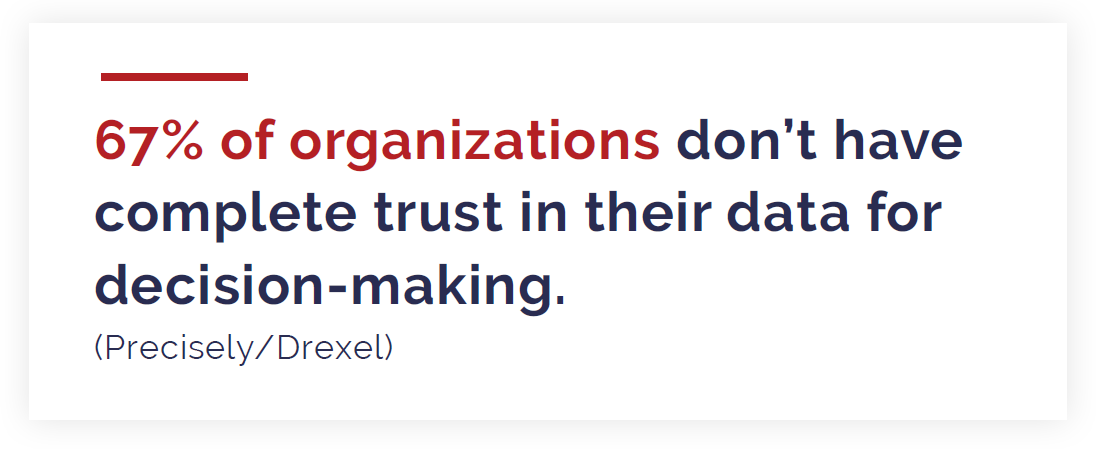
When data has to be “fixed later,” value is delayed, customer data debt compounds, and operational risk increases. In practice, that shows up as missed ROI targets, productivity losses, higher costs from inefficient downstream activation platforms, wasted advertising spend, and even damaged customer trust. A CDP that makes data ready at ingestion creates a trusted foundation instead, one that teams can use immediately and keep relying on as use cases evolve.
What should you look for in a CDP’s identity resolution?
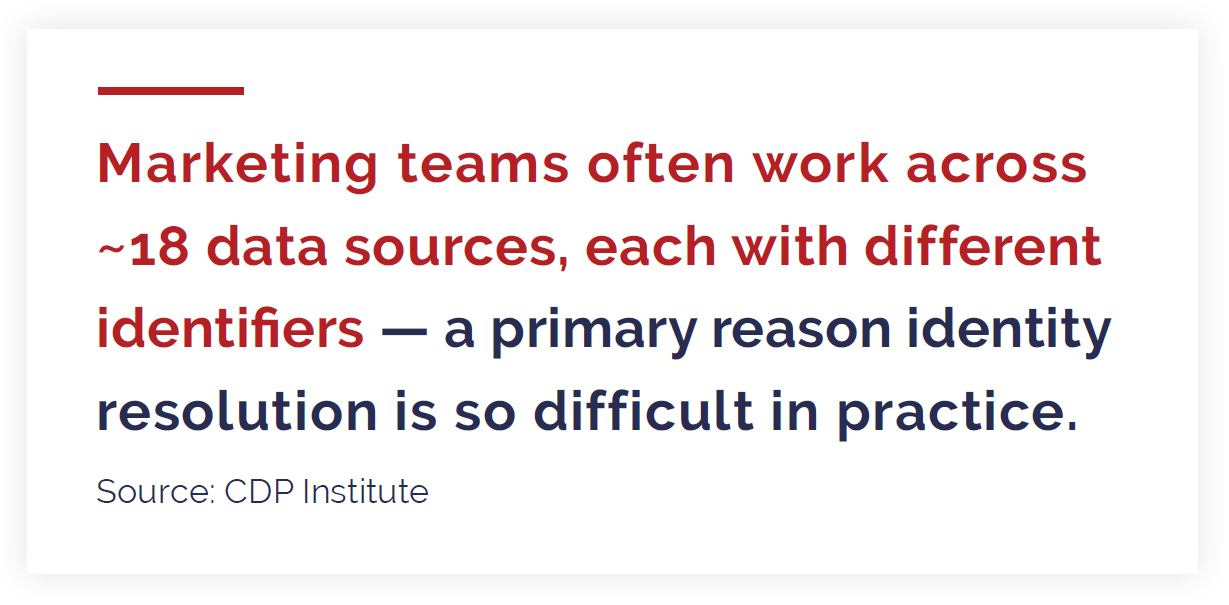
Identity resolution underpins everything a CDP enables, from segmentation and personalization to measurement, orchestration, and AI-driven decisioning. If identity resolution is opaque or inflexible, confidence in the unified customer profile erodes quickly, and downstream use cases suffer. Look for identity resolution capabilities that align to your specific use cases, rather than assuming a single, fixed approach will work for everything. In particular:
- Visible and explainable matching logic, so you can understand why records were matched, merged, or kept separate, rather than relying on a black box you can’t inspect or trust.
- Tunable identity resolution by use case, since different scenarios place different demands on identity strictness. What works for marketing activation may not be appropriate for analytics, compliance, or AI, and a one-size-fits-all model will eventually become a constraint.
- Support for contextual identity, such as householding or account relationships, which provides critical insight for coordinated engagement, frequency management, and delivering consistent experiences across related individuals.
- Persistent identity keys that let you follow a customer’s journey over time, including the transition from anonymous to known, maintaining continuity as new data arrives and identifiers change across channels, devices, and moments.
- Probabilistic identity resolution, not just deterministic matching. Weighted signals and confidence scores better reflect the real-world ambiguity of customer data and enable more flexible, accurate decisioning.
Trust in the customer profile ultimately depends on visibility, control, and persistence. Platforms that excel at identity resolution let you support multiple use cases without reprocessing data, preserve continuity across the customer lifecycle, and build a durable foundation for real-time engagement and AI-driven experiences.
How does a CDP keep data ready over time?
Customer data is never static. Sources change, schemas drift, volumes fluctuate, and quality degrades, often without obvious warning. As use cases evolve from basic activation to real-time engagement and AI-driven decisioning, data that was once “real-time” can quickly become unreliable. Look for built-in data observability that lets teams continuously assess whether data stays fit for its intended purpose, across use cases and over time. In particular:
- Monitor data health metrics such as match rates, profile completeness, and freshness, so both marketing and data teams can see whether the unified profile reflects reality, and whether it’s improving or degrading.
- Identify issues at the source, rather than discovering problems only after campaigns underperform or models produce unexpected results.
- Maintain confidence as use cases evolve, so changes in data sources, identity logic, or activation requirements don’t silently undermine trust in the unified customer profile.
Step 3: Assess Architectural Readiness for What Comes Next
Choosing a CDP is a long-term decision. The architecture has to support change, growth, and interaction models that don’t exist yet.
Can a CDP work with your data without moving it?
Moving large volumes of customer data introduces unnecessary risk, cost, and latency. As data estates grow more distributed across cloud warehouses, operational systems, and real-time environments, success increasingly depends on bringing processing to the data instead of forcing data into a single centralized store. Look for support for a true data-in-place model that fits how your data is already organized and governed. In particular, the platform should:
- Assemble unified customer profiles where data already resides, avoiding large-scale data migration projects that slow time to value and increase operational risk.
- Operate consistently across cloud data warehouses, NoSQL stores, and hybrid environments, rather than assuming a single underlying data architecture.
- Support distributed and agentic systems that need shared, trusted context, so multiple applications, services, or AI agents can work from the same accurate understanding of the customer without duplicating data.
A CDP built for data-in-place architectures minimizes disruption to existing systems while improving performance, security, and flexibility. More importantly, it lets you evolve your use cases, from foundational activation to real-time and AI-driven experiences, without rearchitecting your data foundation.
When does a data-in-place model matter most?
- Customer data is distributed across warehouses, operational systems, or real-time sources.
- Security or regulatory constraints limit data movement.
- Low-latency decisions are required for real-time use cases.
- Multiple teams or systems rely on shared customer context.
- Use cases are expected to evolve without rearchitecture.
How do you avoid vendor lock-in with a CDP?
As customer data ecosystems get more complex, the architecture of a CDP matters as much as its features. Monolithic platforms often promise simplicity, but they can limit flexibility over time, especially as new tools, channels, and AI capabilities emerge. Look for a composable platform that lets you evolve without being locked into a single vendor’s ecosystem. In particular, the platform should:
- Integrate cleanly with your existing investments, rather than requiring a rip-and-replace of your current data, analytics, or activation stack.
- Avoid vendor lock-in, so you can adopt new tools, models, or channels without being constrained by proprietary architectures or closed ecosystems.
- Support incremental adoption and evolution, so your team can start with high-value use cases and expand capabilities over time without re-implementation.
Composable architectures are increasingly critical as organizations adopt AI agents, new interaction channels, and specialized best-of-breed tools. A CDP that’s flexible by design enables innovation while protecting your long-term architectural freedom, so today’s platform choice doesn’t become tomorrow’s constraint.
Does a CDP need to work in real time?
Not every use case needs real-time execution, but every use case has a required cadence. As customer interactions get more compressed, the real question isn’t whether a CDP supports real-time in theory, but whether it can operate at the right speed for your specific business needs, consistently and reliably. Look beyond claims of “real-time access” and check whether the platform can support the cadence your use cases demand. In particular, the CDP should:
- Update the underlying customer profile at the appropriate cadence, including real-time where the use case requires it, rather than relying solely on scheduled or batch updates.
- Support real-time calculations, scores, and decisions when needed, so attributes, eligibility, and next-best actions reflect the most current understanding of the customer.
True real-time engagement is end to end. If any part of the process, such as data ingestion, identity resolution, profile updates, or decisioning, falls back to batch, the experience isn’t truly real-time anymore, no matter how quickly data can be accessed. Real-time engagement requires real-time data readiness, not just real-time access.
Step 4: Ensure the Platform Can Be Used, Not Just Implemented
Even the most sophisticated CDP fails if it can’t be operationalized. Lasting value depends on how easily teams can adopt the platform and turn ready data into action as part of their everyday work.
Who should own a CDP: Marketing, IT, or both?
Many CDP initiatives stall not because of technology limitations, but because ownership is unclear. When responsibilities between marketing, data, and IT are poorly defined, organizations either move too slowly or sacrifice trust and governance in the name of speed. A successful CDP operating model balances self-service for business teams with control and confidence for data teams, so teams can move quickly without reintroducing the very data problems the CDP was meant to solve. In a modern CDP model:
- Data and IT teams own the foundation. They’re responsible for data ingestion, identity resolution logic, quality standards, governance, privacy controls, and overall data readiness. Their job is to keep customer data accurate, consistent, compliant, and continuously fit for use.
- Business teams own activation and outcomes. Marketing and CX teams own segmentation, audience strategy, activation, testing, and optimization. They should be able to explore and act on trusted data without needing to understand how it was stitched together or governed.
- The platform enforces guardrails, not gatekeeping. Governance, identity rules, and quality controls should be embedded in the platform itself, so teams are guided toward correct usage instead of blocked by manual processes or approvals.
When ownership is clear, the CDP becomes a shared capability instead of a bottleneck. Data teams keep confidence in the customer profile, while business teams get the speed and autonomy they need to deliver consistent, personalized experiences at scale.
Can marketers use a CDP without IT or coding help?
Adoption drives ROI. Even the most powerful CDP fails if data access is gated by IT, complex workflows, or brittle pipelines. To deliver value, business teams need fast, intuitive access to trusted, ready-to-use data, without creating new risks or bottlenecks. A modern CDP should empower marketers and CX teams to:
- Build, refine, and test segments visually, using identity-resolved, governed data.
- Explore audiences and surface insights without relying on SQL or data engineering support.
- Activate data across any channel, including email, paid media, mobile, web, and emerging destinations, without custom code or one-off integrations.
At the same time, this self-service access has to sit on top of a strong data readiness foundation. Business users should be able to move quickly, while data teams keep confidence that the data stays accurate, compliant, and consistent across every activation.
How does a CDP support AI?
AI success depends less on algorithms and more on the quality, consistency, and timeliness of the data feeding them. As organizations move from experimentation to production AI, the CDP’s job is to make sure customer data is not just accessible, but clean, unified, governed, and ready for AI use cases. Look beyond surface-level AI features and check whether the platform gives you the right foundation to support AI today and adapt as approaches evolve. In particular, the CDP should:
- Make customer data AI-ready by design, with in-line data quality, identity resolution, and governance that reduce noise and bias before data is used for modeling or inference.
- Support AI execution both inside and outside the platform, integrating with external AI tools and services rather than forcing all intelligence to live inside the CDP.
- Enable real-time inference and attribute calculation when required, so AI-driven scores and decisions reflect the customer’s current state.
- Allow customer-owned models and analytics alongside native capabilities, preserving flexibility and avoiding lock-in to a single vendor’s AI approach.
The stakes are real. Forty-two percent of enterprises say more than half of their AI projects have been delayed, underperformed, or failed due to data readiness issues, according to a Fivetran survey.
From CDP Selection to Sustainable Value
Choosing a CDP was never about finding the platform with the longest feature list. It’s about choosing a foundation that gets your data ready for any AI or CX use case you take on next.
The role of the CDP is changing. It’s no longer just a destination system or a marketing tool. It’s the connective layer that keeps customer data trustworthy, usable, and ready as channels change, expectations rise, and AI becomes part of everyday decisions.
Organizations succeed with a CDP when:
- Use cases are clearly defined and continually refined, grounded in real business outcomes.
- Data readiness is a core capability, not an afterthought, ensuring data is fit for activation, analytics, and AI from the start.
- Architecture is built to adapt, supporting new technologies and strategies without rework.
- Teams move with confidence and speed, acting on data they trust across every touchpoint.
This is what separates CDPs that get implemented from the ones that become indispensable. The real value of a CDP isn’t measured at launch. It’s measured in how well it lets the business evolve, experiment, and grow over time.
Learn more about CDPs: redpointglobal.com/cdp